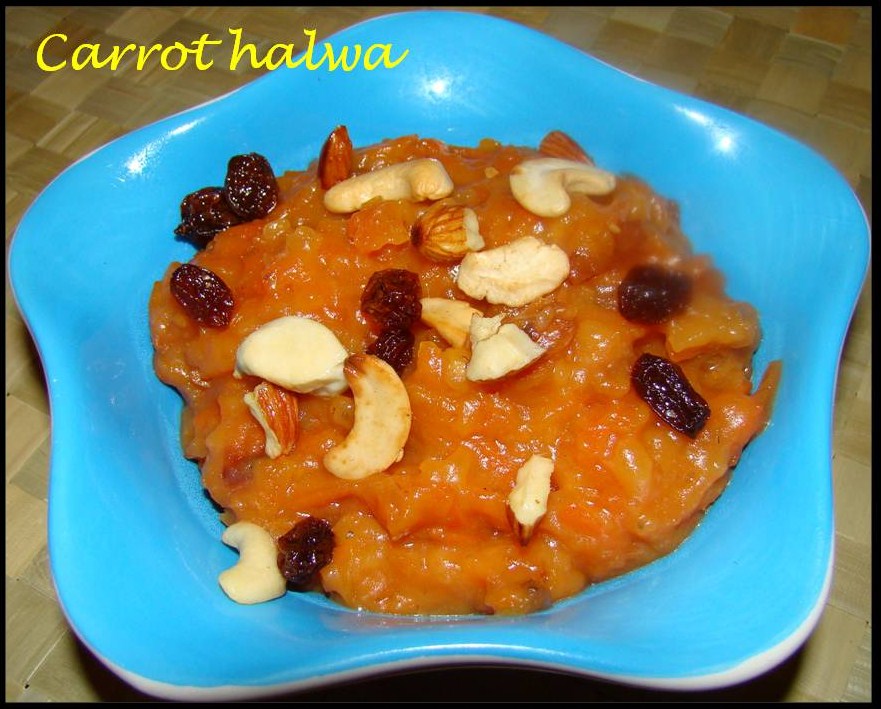
Carrot hawla

Gajar ka halwa or carrot halwa is a  very nutritious and tasty Indian sweet dish. It is a very simple process; nothing can actually go wrong here. By using evaporated or half-half, cooking time will be drastically reduced.
1 lb Carrots
1 can Evaporated Milk or 1 cup Half-half
1½ cups Sugar
4 tsp Ghee
½ tsp Elachi powder
2 tsp Raisins
2 tsp Almonds
2 tsp Pistachios
2 tsp Cashew nuts
Few strands of saffron
1 tsp Rice flour

Wash and peel carrots. Finely grate them, keep aside.

In a large non stick pan take 3 tsp of ghee, when warm add all nuts and then raisins, fry them till golden yellow. Remove the nuts and raisins from the ghee to a bowl. Keep aside. To the remaining ghee add another tsp of ghee and add the grated carrots, fry till the raw color changes. Then add a can of evaporated milk or cup of half-half and cook for a few minutes.
Now add sugar, elachi powder and 1” butter or ghee. Cook on medium heat and keep stirring regularly. When it all comes close together add a tsp of rice flour. Rice flour acts as a binding agent and brings all the ingredients together. Add all the friend nuts and mix well or arrange on the top. And garnish with saffron.

Grease the serving bowl and transfer the contents into it.

Carrot halwa can be served warm or cold, it’s a personal choice. Enjoy it with fresh whipped cream or vanilla ice cream for variation. I have see people enjoying hot jelabi with carrot hawla and if you are like someone I know, warm halwa with roti for dinner!

White vatana sundal

2 cups White vatana (Whole yellow peas, the peas look quite similar to garbanzo beans ( chick peas), except that they are smaller in size and white in colour.
2 Onions
3 Tomatoes
2 - 3 Green chilies
1 tsp Ginger-garlic paste
½ tsp Amchur/Dry mango powder
½ tsp Cumin-coriander Powder
½ tsp Garam masala
¼ tsp Red chili powder
Coriander

Soak white vatna over night. Cook in a pressure cooker with salt with a pinch of turmeric till they are soft. Do not overcook; just about right otherwise they become very mushy. Drain and keep aside.

Take 3 tsp of oil in a non-stick pan and make tadka with mustard seeds and jeera. When it starts to sizzle, add very finely chopped onions and chilies. Keep stirring at medium heat till the onions are translucent. Add ginger- garlic paste and fry for a few minutes. Then add cut tomatoes, cook for a few minutes and then add amchur powder, cumin- coriander powder, garam masala, red chili powder and salt.

Mix in cooked vatna, taste for salt and adjust the seasonings. Add some lemon juice and garnish with coriander, serve hot.

This is a very filling dish, a pot dish that can be eaten as is or can be served with roti. The same base can be made like a gravy dish by adding water and can be served over potato patties. This is the famous ragda patties on Mumbai streets!

Cashewnut chikki

Srirama Navami Subhakanshalu (03/24/2010)

Chikki is a traditional Indian sweet prepared with any edible nuts or with mixed nuts and sugar/jaggery. The preparation is quite simple. These are finger deserts that are hassle free and easy to eat!

Cashew nuts, like all nuts, are an excellent source of protein and fiber. They are rich in mono-unsaturated fat which may help protect the heart. Cashew nuts are also a good source of potassium, B vitamins and folate. They contain useful amounts of magnesium, phosphorous, selenium and copper. (source: Wiki)

I have to mention here the chikki made in Lonavala, Pune. They are simply mouth watering and will leave us craving for more! One piece is never quite satisfying. I love their pistachio, mixed nuts chikki.

Traditional chikki are made with peanuts but, I am a cashew person, so..

1 cup - Roasted cashewnuts (sliced or whole)
1 ¼ cup - Jaggery
2 tsp Ghee

Roast the nuts on low flame in ghee and in the case of peanuts remove the skin.

Take grated jaggery in a kadai and add ¼ cup water and on medium flame bring to a boil till it thickens. Perform the ball test, drop some syrup drops in cold water and try to roll it to form a ball if it is like a string, it needs to be cooked a bit more.

Filter the jaggery syrup to remove any impurities. (Avoid if you trust the jaggery). I buy mine at the same store always!

Once the syrup is ready, add a tsp of ghee to the syrup switch off the flame and immediately add the roasted cashew nuts. Stir and mix well.

Grease a parchment paper and pour the hot mixture on it. Roll it with a rolling pin and let the temperature of the mixture come down. Lumps of mixture can be rolled into a ball in the palm of your hand or cut into any desired shape.

Store in an air tight box, they have a good shelf life.

White turmeric (Mamidiallam) in lemon juice

A member of ginger family, white turmeric is a rhizome. Its flesh is a lighter than common turmeric; its flavor, however, is not as subtle, and some roots can be quite pungent.

Turmeric is known to be used medicinally for ulcers, parasitic infections, various skin disorders, strains, bruises, inflammation of the joints, cold and flu symptoms, preserving food and as a digestion aid.

This special turmeric is very rare and seasonal. But, I am able to see it regularly in the Indian groceries here. This is a simple dish, where all the properties of the ginger are intact and tastes great at the same time.

¼ lb Mango ginger/ white turmeric - Mamidiallam
5 – 6 Long Green Chilies
Lemon Juice
1 tsp Vammu

Wash and peel ginger as much as you can, it is really difficult to peel it all, leave the rest of it and cut into small pieces. Chop green chilies into small pieces, use enough to suit your taste. I use Cayenne or milder green chilies for relishing the raw taste of the chilies.

In a glass bowl squeeze lemon juice and add chopped green chilies, vammu (raw), salt and turmeric. Add chopped ginger pieces. Mix well and let sit for 1 -2 hrs before serving, by doing this, vegetables will absorb the lemon juice and the seasonings.

This can be used as side dish with rotis and as an accompaniment with dals, curries and rice. Store in an air tight glass bowl, in the refrigerator for up to a week. The citric in the lemon juice will not let it go bad.

Ugadi Subhakanshalu

Vikruti Nama Samvatsara Subhakankshalu.
March 16th 2010

In Sanskrit, Prakruti means "Nature" or "creativity"and Vikruti is "the adnormal state" or "the diseased state" of the body in Ayurveda. So, lets eat well, be healthy and lead a happy life to ward off an evil.

Wishing all my dear friends, family and readers a very happy Ugadi.

Madras sambar powder

I used to get my sambar powder from Grand sweets, but a friend has given me her grandmother’s treasured sambar podi recipe years ago and, with her permission I am publishing it here today. If you are buying a local brand or MTR, I suggest you give this a try and you will be surprised by it's taste.

¾ cup Urad dal- Minnapappu
½ cup Chenna dal – Senagapappu
½ cup Toor dal – Kandipappu
1 cup Coriander seeds- Dhania
Handful Red Chilies
1 ½ tsp Jeera
1 ½ tsp Mustard seeds
2 tsp Fenugreek seeds
2 tsp Black Pepper seeds
Hing
2 Handfuls curry leaves
4 tsp Grated coconut

Take 2 tsp oil in a skillet fry coriander seeds till they are done. Then add channa dal, toor dal and fry for a few minutes finally add urad dal, fenugreek seeds, jeera, mustard seeds, black pepper, hing, curry leaves and red chilies. At the end add grated coconut and fry till it is nicely done.

This order should be followed as coriander seeds take longer time to fry than the other dals. Red chilies can be adjusted according to taste.

It is really important that the mixture is stirred frequently and have the flame in low/ medium. This way the dals are roasted completely and prevents from darkening. The mixture emits a toasty aroma when they are nicely roasted.

Let cool. Grind to a powder in a spice mill or blender.

Use immediately or store in an airtight container in a cool, dry place or in a Ziploc bag in the freezer to retain its freshness and aroma.

Sambar powder is used for making sambar and other “pulusu” – Liquid dishes. All the items in the mixture will have a unique blend and when mixed with tamarind juice, vegetables and made sambar, the flavor will come out.

The key to good sambar is no doubt the podi but the toor dal should also be cooked very softly and mashed well leaving no visible dal. Weather you pressure cook or cook vegetables on stove top, do not overcook the onions and vegetables and use required amount of tamarind. Using hing, curry leaves and garlic (optional) in the seasoning will make it even more special.

Chili Idle

Sometimes you have left over idle's not enough for the whole family or want to fix a quick heavy snack or starter, here is a good idea. Fried idle and chili idle have become regular starters in Indian Restaurants. I hope they are not using left over's like I said! It could be a spicy dish but reduce the heat (karam) if you want it milder.

Idle - steamed and cooled. (Please refer to idle recipe in Brunch/Breakfast)
Peppers: any variety
Green/Yellow/Red Peppers
2 Large Onions
1 tsp Ginger-garlic paste
2 tsp Red chili paste
Coriander
Lemon Juice

Small button idle will be ideal, if not cut the regular idle into 4 pieces.

Take a large non stick vessel and add oil and make tadka with jeera and mustard seeds. Sauté' chopped onions and add ginger garlic paste. The add cut peppers and fry till semi cooked. Do not overcook. Now add salt and red chili paste and mix well.

Add idle and give it a good stir. Be gentle. Remove from flame and garnish with coriander and lemon juice. Serve warm.